Site description

A blog for electronics professionals, amateurs, hackers, and anyone interested in the world of electronics.

11 April 2011

*Sigh* - Work, Employment Agencies and CVs / Resumés - A Little Advice

(Note to non-British English speakers, C.V. = Resumé)

Before I start, part two of the precision LCR meter will be along shortly. It is all written up, but still needs a couple more diagrams drawing. What can I say, the weather here in the UK at the weekend was absolutely glorious; sunny and warm, with all the spring flowers out. After a long and miserable winter I didn't feel like staying inside and doing computer things. Sometimes even the most techy of engineers has to take a step back and spend some time being an analogue human being.

Don't You Just Love Employment Agencies?

Anyway, here we are. Another Monday, another annoying employment agency. Actually no, just the same employment agency, again. To recap, a few weeks ago I received a phone call from an employment agency who had seen my business details in a trade directory (Electronics Yorkshire) and wanted to know if I was recruiting. I said that I was not, as my business consists mostly of me, with the occasional assistance of some trusted hardware and software people that I have known a long time. After hearing this, they couldn't get off the phone quickly enough, but were very polite about it. So far so good.

A couple of days later I received an email from the aforementioned agency, with an attached CV. To be fair, the email did say "If this candidate is not relevant to you, please let me know and I will amend your details" so I emailed them back, explained that I was not recruiting and would they please stop sending me unsolicited personal information. I don't think it is fair on the candidates that their information should be shown to complete strangers, and to people who could potentially be their current employer. Even with basic personal details redacted, it isn't that difficult to tell who they are if they currently work for you.

Just four days later, I got yet another email with the title "AVAILABLE ELECTRONICS ENGINEER" (I do find that titles in all capitals really help, don't you?). Despite redactions, after 30 seconds on Google I had the candidate's name. 4 minutes and I had his address. The power of the Internet is scary sometimes. Unfortunately not powerful enough to supply me with an email address for the engineer concerned or I would have let him know what his agency were doing with his personal information. Would a paper snail mail be over the top? Probably. I think most engineers are cynics anyway, and rarely amazed by what agencies get up to.

Today I received a third CV from them - entitled "Available Embedded Software Engineer". Sounds like they are diversifying, I wonder how long before they are sending CVs from Control Systems and HVAC engineers. Still, "know your enemy" is a useful maxim, and it is always good to see what the competition are offering, so I thought I should have a look at it. I'm glad I did. If these CVs are anything to go by, I am seriously under-valuing my skills. I am also nowhere near as good at spouting bulls**t as I should be. Yes, I can tell this surprises you.

Like most people, I hate writing my CV and am never totally sure what to put in and leave out. There seem to be as many "correct" ways to do it as there are employers. Even so, I was amazed at the quality of this particular CV. Or the lack of it. So amazed that I thought I should blog about it; partly to amuse and partly to show younger engineers and students what they shouldn't be doing.


Writing Your CV - Some Advice.

First things first. Four pages is way too long for a CV. Two or maybe three pages is plenty to get across the bare bones if your history. Details can be given on additional sheets if you need to, or on a password secured web page. This way you can make your relevant details available live, and you can ensure that they are up to date. Any sample documentation or photos of your work is a bonus, but don't put it in your CV.

Get someone to proof-read your CV. 

There will be spelling and grammar mistakes in your CV that your eyes just don't see, just like there are in this blog. If you are dyslexic (and many creative people are), or English is not your native language, then there is no excuse for not getting someone to check it over for you. You would really hope that a good employment agent would check it over too. A CV is a hugely important document which exists to get you an interview and it is representing you as a person, so check your personal statement particularly carefully. For example, do not write the following:

"I am (a) very determined and enthusiastic individual with (a) very clear understanding of my future goals. I would like to peruse (pursue) my career with a company which will give me early responsibility and is committed to staff training. I have a firm believe belief in myself and my abilities to meet any challenge as my career progresses forward."

Sorry about getting all schoolteachery there - the red text and strike-thoughs are my additions. Yes, this is from the CV I was sent today; 6 mistakes in 55 words, half of them in the first sentence. A 31 year old engineer who doesn't know the difference between peruse and pursue, or believe and belief, and is asking for "Between £34,500 and £37,000 (negotiable)". It is hardly surprising though, most agencies don't seem to know the difference between principal and principle. If you don't know why I have corrected "future goals" and "progresses forward" then you should read up on tautologies.

A word about the content: at 31 you are also no longer a fresh graduate, and responsibility at that age is not "early". Good luck finding a company with staff training. Most tech departments now are quite small and don't have any formal training.


It is not what you write that matters, but what you leave out.

Part 1: Experience

This works in two ways. First of all, employers are really not interested in what you did for a few hours once. If you are getting a job based on a small amount of experience then you will get found out quickly anyway. Cut to the chase and tell them what you can do well. Secondly, don't tell them what you are bad at! I'm not going to quote the poor sod's CV here there is no point. Briefly:-

18 lines of "IT/computing and technical skills"  (is there a difference?) of which 4 skills are described as "basic" level. In a list that big, those 4 can comfortably be dropped. Otherwise it drags down your perceived average. What are you good at? I mean really good, not just something you did for a week or so. Being able to wire an RS232c lead is not an outstanding engineering skill.

28 lines of text describing what you did for 3 years at one particular company, many of which are describing the same thing in a different way. I lost the will to live after 5 lines (hey, reader, if you made it this far then well done!) 

The more specialist your skills are, the less you should need to write in your list. Target them at whatever role you are applying for too. If you make your lists hard work then your CV will get binned in no time.

Part 2: Qualifications

What matters most to any employer is what you are now and what you can do. A word to Mr Anonymous-CV-Owner: When I saw the marks for every single chuffing test you have done in 4 years of University (yes, he really did, all 34 of them), I did rather wonder how the University of Bradford managed to award a 2:1.

Now, there are some decent scores in there, mostly in the mid 60s, with a couple in the 80s, but what my brain sees are these:
Radio Transmission and Reception  40%
Signal and Systems Theory 47% 
Financial Management 45%                        
Embedded Systems 45%
Analogue Electronics 1  48%
See where I am going here? You got a 2:1 and my brain is seeing just-scraped-by marks, especially the one in embedded systems - and you are applying for an embedded software job. The thing is, most of us have marks like that! I have never, ever, been asked for my individual test marks. Which is probably a good thing, because I have no idea where they are. So don't tell them! Instead, just say you have a 2:1 B.Eng. Honours. and an M.Sc. If they want details then supply them, but not until then.


The Elephant In The Room

I was once in an interview (oddly enough with a company that was a spinoff of our hero's University) when the interviewer said a surprising thing. He said I should always attach a photograph with my CV. I asked why. In not so many words, he said it was because I was 6ft tall, slim and, quite frankly, white. He didn't say white, but he used many many words to avoid saying so. Ever since then I have declined to add a photograph to my CV. I know this is probably strange coming from an Anglo-Saxon white male in Middle England, but I want to be judged on my abilities not my skin colour.

Our hero lists his under-16 education as a Foundation College in Pakistan. With the best will in the world, that could be the Eton or Harrow of Pakistan and I wouldn't have a clue. However good they are, you can be pretty sure that any employer will not rate it as highly as UK GCSEs, and it is going to be very difficult to verify your marks.With a Masters Degree and experience under your belt, I would only add details of my pre-16 education if I got stunning results in the locally accepted examination system.

Under "Additional Skills, Activities and Interests", he also lists Languages: Urdu and Punjabi (Fluent-native). This does partially explain the standard of English (although not why it wasn't checked), but why include it unless you know it is necessary for the job? Why not list English too? Don't give the person filtering out CVs any excuse to be in any way racist. Don't pretend to be something you aren't, but instead persuade them to concentrate on being able to do the job.

What It All Boils Down To

Remember, when applying for a job, of all the people you come into contact with, only one has the power to say yes. All the rest are there to say no. Give them as few reasons as possible to filter you out.


Oh, Just One More Thing...

If you are an employer or an engineer looking for work in the UK, the name of this agency is Progressive Recruitment, based in Manchester. Use your own judgement as to their standards, just consider that they don't read emails, and that they send out personal CVs to people who haven't requested them.

30 March 2011

The Amp Hour #36 — Big Business Buffoonery

The Amp Hour podcast is essential listening for anyone interested in electronics. Dave Jones, Chris Gammell (and occasional guests) have a chat and a rant about life, the universe and electronics. Well, mainly electronics if I'm being honest. Great entertainment for the drive to work, or something to listen to rather than the bloke at the next desk. Unless you work in Ohio or Sydney, in which case one of them might well be the bloke at the next desk!

Yeah, they might possibly have mentioned my LCR meter project too. Cheers guys!

The Amp Hour

23 March 2011

Design for a Precision LCR meter (AKA: Prospero Gets a Brother) - Part 1

I suppose this project should really be called Antonio as it is the brother of Prospero, but it doesn’t exactly sound right for a piece of test equipment. An appropriate name evades me for the moment. It is probably just as well.

Measuring Inductance, Capacitance and Resistance.
In designing Prospero (the RF vector network analyser) it has come to my attention that the inductance and capacitance measuring equipment currently available to me isn’t exactly precision lab reference grade. A resolution of 1nF isn’t really good enough when you are working at sub-pF level. Upon investigating, it seems that a basic LCR (Inductance, Capacitance, Resistance) meter starts at around £150. If I want to measure the equivalent series resistance (and I do) then I am looking at upwards of £250. Hmm. I don’t really have that sort of money to spend on another meter, so just what is an engineer to do? 

Well, after an amount of thought (somewhat less than a second), I decided that building my own was probably the best way forward. But then you knew that didn’t you! 

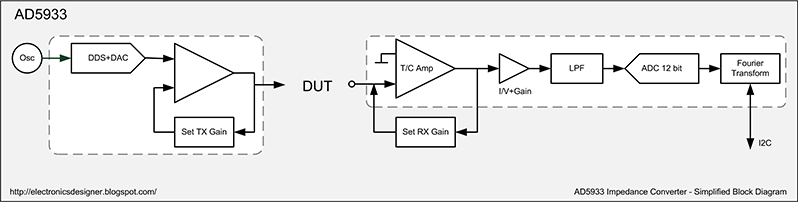
So, what architecture? There are plenty of simple embedded micro based meter designs around, but they are all designed around similar methods and are rather limited in range and accuracy. I had specified that the unit be capable of a test frequency of at least 100kHz and most units seem to stop at 10kHz. That inherently reduces the ability to read small value components with a good degree of accuracy. I remembered that a few years ago I was sent a sample of Analog Devices’ AD5933 1MSPS 12-bit Impedance Converter. I had meant to do something with it, but it has certain limitations (which I will go into later) and at that time I was working in a lab which had nice test gear, so the chip got filed away. After a good read through of the data sheet however, I decided the AD5933 would probably take a lot of leg work out of my design and was good enough for my purposes.

Fig.1 AD5933 Impedance Converter - Simplified Block Diagram


Never Satisfied
As I mentioned, the AD5933 isn’t perfect. The 10-bit DAC generates spurious signals outside the desired band (although the LPF filters many of these out in the receive section) it is inherently very poor at measuring low impedance values, and the maximum text frequency is limited to 100kHz. Ideally I would have liked 1, 10 or even 100MHz available to test RF components. So I set to work to design something of my own. The first result is reproduced below.

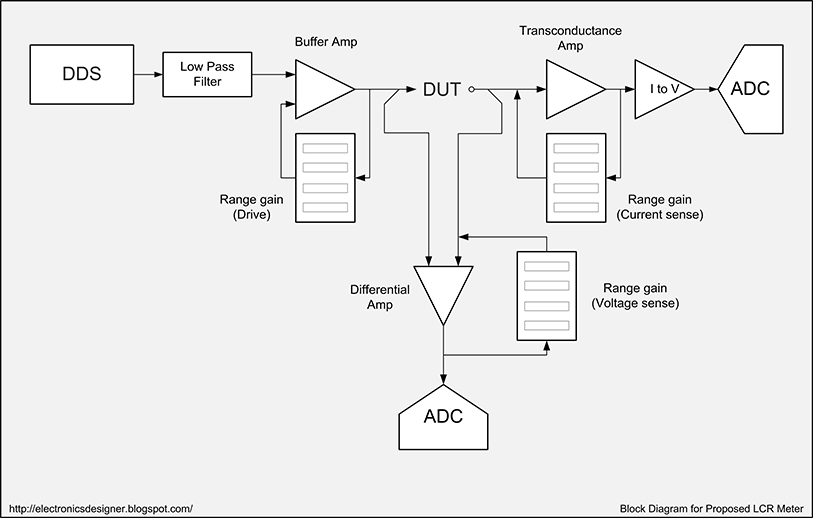
Fig.2 Improved LCR Meter Design - Block Diagram

The intention was to DDS generate a clean 24-bit sinusoidal signal in software (probably with an ARM Cortex M3) and do the D-A conversion with a fancy hi-fi  chip (they really are absurdly cheap). They can be pushed to well over 200KSPS, giving a precise and clean 100kHz source with only a little filtering. Simultaneous measurement of the current and voltage components is to be done with another 24-bit 200KSPS+ hi-fi ADC chip and streamed into the processor via DMA.

To give flexibility, the output is capable of driving peak-to-peak levels between 0.01V and 10V at up to 10mA, with programmable offset. Voltage is sampled across the test ‘probes’ in a 4-terminal manner, with a set of programmable gains to ensure the best possible use of the ADC’s dynamic range. Current is measured via a transconductance amplifier (again with programmable gain) which produces a voltage proportional to the current through it, but without the ‘burden voltage’ associated with a simple resistor as used in most current measurement.  This is then presented to the second ADC channel. After grabbing a large enough sample, software performs a simple Fourier conversion to the frequency domain. Comparing phase and magnitude gives us our desired parameters.

However…

In one of those moments to which most engineers are prone, I decided that wasn’t enough. I really needed 1/10/100MHz and had 14-bit 400MSPS DDS chips in stock. I could use one signal as a source, and a second (coherent) signal to compare the phase in a mixer, reading the magnitude in an ADC. Excellent.
One slight problem though. What I have actually described there is a network analyser. Basically it is a cut down version of Prospero, limiting at 100MHz instead of 500MHz, and not being able to measure the reflected signal. So what is the point making it when I will have a better tool in my hands before long? None at all! Sigh. I had gone around in a huge circle.

Back To The Beginning!

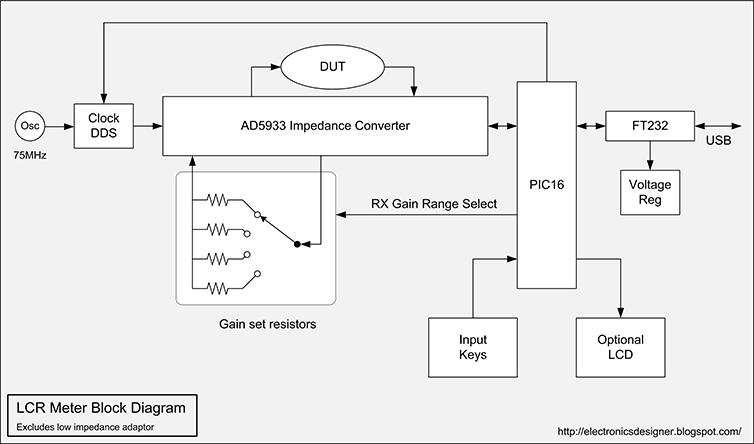
Anyway, I decided to go back to the start and go with the original AD5933 design. It can be modified to handle low impedance values, and the addition of a cheap external DDS makes the clock scale down to audio frequencies, which is handy for audio components such as loudspeakers etc. As you can see from the diagram below, the current sense gain will be selectable.

Fig.3 LCR Meter Block Diagram - Excluding Low Impedance Adaptor

Control is to be done via a simple PIC16, with connection to the PC via an FTDI USB module. In theory I could probably bit-bang the operation from the FTDI module, but that would probably end up being more expensive and more complex than a cheap and fast PIC16. With an on-board micro, I could build in an LCD and do all the maths on the embedded micro but, to be honest, it isn’t going to move outside the lab, and it is far easier to do more exotic maths on a nice fast PC with a good display. Nevertheless, I will probably provide the appropriate connections to drive a standard LCD text module.

For the moment, it is my intention to derive power from the USB connection. The entire system is low power, with the AD5933 drawing a nominal 10mA at 3V. Dropping from 5V to 3V also gives me the opportunity to provide more precise voltage regulation than USB gives, and also the ability to remove noise on the power lines, both of which improve the accuracy of the system.

In Part 2 I intend to cover the design of the low impedance adaptor, how the current range is selected, and some ideas on how the system accuracy can be improved beyond the 0.5% claimed for the AD5933. Until then, toodlepip!


17 March 2011

The Brotherhood (and Sisterhood) of Engineers

I have an awful lot of updates to write; The designs of Prospero and Miranda (Vector Network Analyser and JTAG programmer respectively) are coming on nicely, and there is a huge amount to say. But I am not going to, at least not yet. There are much more important issues I need to speak about.

Japan. One week on and things are at least starting to be a little clearer, but the media are largely still hysterical and uninformed. Even respected sources such as the BBC, CNN and New York Times are having trouble getting good quality information. For example, the BBC was presenting the loss of coolant in the used fuel storage tank as "current" more than 18 hours after the event. Media outlets are even copying things off each other, ending up with a strange sort of echoing feedback loop. Instead of reporting the known facts, they are falling back on the old method of wheeling in some supposed expert or other, who is then made to hypothesise what may be happening. The Japanese broadcaster NHK is not massively better, but at least seems to have faster access to what facts there are. You can currently stream NHK here via Ustream: http://www.ustream.tv/channel/nhk-world-tv . Their main fault is not displaying a "repeat" caption on video that might be an hour or two old, giving the impression that it is live.

Enough complaining though. I do not propose to cover the horrendous humanitarian situation. Far better people than I have written about it, and anything I could add would be pointless. You have seen the photographs and the news footage, they all speak louder than words.

My first comment is what happened in Tokyo. Or rather, what didn't happen in Tokyo. I don't know for sure what the earthquake measured in the city centre, it would be considerably less than the 9.0 at the epicentre, but still up around the 7.8 level. Beyond what they were theoretically designed to withstand.

If you are an engineer (of whatever discipline) you will know that engineers share that intangible "something". Whether you are in electronics, automotive, structural or civil engineering, we all share the universal foundations of maths and science and a similar outlook on life. The attitude of doing the best you can, going that bit beyond the specification, to make the best possible product, whatever it happens to be. Because you just never know when that little extra can make a big difference.

Quite often, when we do our jobs right, nothing happens. A Formula 1 car crashes backwards into a concrete wall at 150 mph and the driver walks away. The media call it luck, or maybe God's will. What they rarely mention is the truth: Thousands, possibly millions of hours of hard work by clever, educated, experienced engineers. To every single one of the architects, designers, testers and yes, even you bureaucrats who came up with and enforced the Tokyo building regulations, you have my utmost respect. So far as I am aware, nothing happened. No pictures flashed around the globe of skyscrapers that collapsed. No footage of thousands of sobbing bereaved Tokyo people. Other areas weren't so lucky, with fires breaking out and many people losing their lives. Let us hope that in future years that those areas can enjoy nothing happening too. It won't be luck that does that. It won't be God. It will be engineers. Invisible, un-named, unseen. Working hard to make sure nothing happens. That makes me proud.

Events move on however, and all the airtime is now being devoted to the Fukushima Daiichi nuclear plant. I'm not going to say much about nuclear plant engineering. At this time we don't have much information about how things failed and what the mechanims were, so it is difficult to say anything except to ask why they think it is a good idea to build nuclear plants near sea level on the coast facing the Pacific tectonic plate boundary, which has historically experienced powerful earthquakes and tsunamis. I believe nuclear power has a big future in the future low-carbon world, but not if they build fundamental weaknesses into power plants, relying on luck for nothing to happen.

Finally. I don't have many heroes on my list, and there are certainly no overpaid footballers or other sportsmen and women on it. The emergency workers who ran into the World Trade Centre towers when any normal human being would have been running away are certainly on it. Hell yes. I think that list has just acquired some more names; The engineers, technicians and others who are currently battling to stop Fukushima Daiichi nuclear plant becoming a hot Uranium dust emitter. These people must know that their lives are probably going to be severely shortened by what they are having to do. Ladies and gentlemen of Fukushima Daiichi plant number 1, you have my profound respect and admiration. Japanese popular culture has a long history of heroes and superheroes. I suspect they have just found some real superheroes, whose actions will be remembered long into the future.

I salute you all.

4 February 2011

Design Spark - Sort out your spam filters! & Electronics Engineering Heroes.

I am posting this in reply to an item on RS's Design Spark site entitled "Electronics Engineering Heroes".Why am I posting it here? Well it seems to think I am a spammer and won't accept my submission. No appeal, no resubmission. Nada. Nice one RS. I invite anyone reading this to view the original article, without which this post will mean very little!

Steve Jobs was most certainly not the engineer, he was (and remains) a marketing genius. Steve Wozniak was the engineer.

What does that say about engineering? That, subconsciously, even an engineer chooses a marketing man to symbolise engineering. Similarly, in the story of the transistor, William Shockley was largely a manager, and wasn't involved at the time the point contact transistor was created. The field effect transistor had previously been invented by several other people working independently, as long ago as the 1920s. I guess there was no marketing man handy to spread the word

If you want real electronic engineering heroes, try Robert Watson-Watt the British RADAR pioneer - other RADARS were being developed, but it was Watson-Watt who managed to make the concept "fly", and without which we would have lost the Battle of Britain.


Equal with Watson-Watt was Tommy Flowers, the man who was able to make the WWII "bombe" decryptor, and went on to design Colossus. The engineering was not in making it, but in getting it to run reliably, something which was considered impossible as it used nearly 2000 thermionic valves (tubes). The payout which the government gave him at the end of the war didn't even cover his personal investment in equipment.

Sadly, because both these men did their work during the war, a vast amount of it was an official secret and wasn't publically recognised until the 1980s.

11 January 2011

6502 Factoid De Jour

Today's 6502 related fact - It seems that the 6502 was largely designed and taped out by ONE person, Bill Mensch. The one huge benefit of this was that the 6502 was right first time. This adds fuel to my hypothesis that the more people you have on a project, the more it is likely to fail. Similarly, the ARM architecture was designed by two people, one a hardware specialist (Steve Furber) and one a software specialist (Sophie Wilson), neither had much in the way of resources. The result was a processor that is in 90% of the world's mobile phones, and without which the iPhone just wouldn't be possible.

Keep your teams small!

10 January 2011

Reverse Engineering the 6502 - How they did it

A few weeks ago I posted a link to www.visual6502.org which perfectly simulates the famouos 8-bit micro which was used in a huge range of computers. The same people have posted a series of lectures explaining how they did it, and what their future plans are.